

Taxation in Brazil for Foreign Investors: Essential Concepts
Entering the Brazilian market is a strategic milestone for many international companies. However, the transition from planning to operation often reveals a critical challenge: navigating the country’s complex tax environment. Understanding taxation in Brazil for foreign investors is not merely a compliance exercise; it is a fundamental pillar of financial viability and corporate governance. For global businesses, a lack of localized tax strategy can quickly translate into unexpected costs, regulatory penalties, and operational delays.
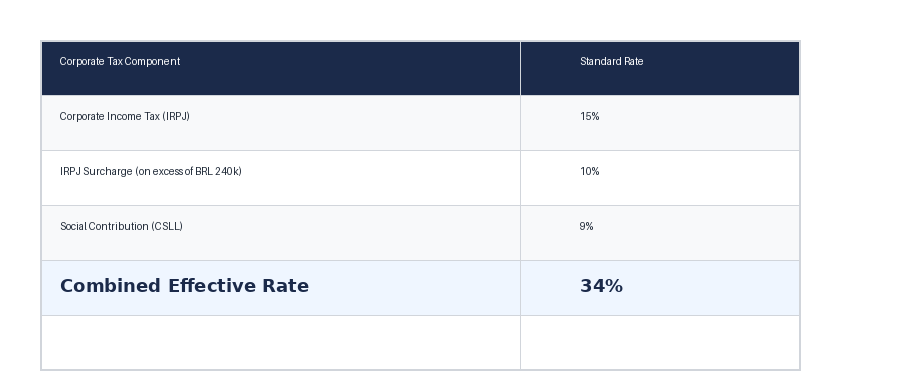
The Brazilian tax system is widely recognized as one of the most intricate globally, comprising over 90 distinct levies across federal, state, and municipal levels. This complexity requires foreign investors to approach their market entry with meticulous planning, robust accounting structures, and a deep understanding of local regulations. According to PwC Tax Summaries, Brazil’s corporate income tax (IRPJ) is assessed at a fixed rate of 15% on annual taxable income, with an additional 10% surcharge on income exceeding BRL 240,000, resulting in a combined effective rate of approximately 34% when including the Social Contribution on Net Income (CSLL) at 9%.
The Corporate Tax Landscape in Brazil
For foreign entities establishing a presence in Brazil — typically through a wholly-owned subsidiary or a branch — understanding the core corporate tax burdens is essential. Brazilian resident companies are subject to taxation on their worldwide income, meaning both domestic and international profits are considered for tax purposes. Non-resident companies, on the other hand, are generally taxed only on income generated locally.
The primary corporate income tax framework consists of two major federal levies: the Corporate Income Tax (IRPJ) and the Social Contribution on Net Income (CSLL).
The Corporate Income Tax (IRPJ) is assessed at a basic fixed rate of 15% on annual taxable income. Additionally, a surcharge of 10% applies to any portion of the annual taxable income that exceeds BRL 240,000. The Social Contribution on Net Income (CSLL) is generally levied at a rate of 9% for most legal entities, though specific sectors such as financial institutions face higher rates of up to 20% . It is important to note that the CSLL is not deductible for IRPJ purposes. When combined, the standard effective corporate tax burden in Brazil typically reaches 34% for companies exceeding the exemption threshold.
Choosing the Right Tax Regime
One of the most strategic decisions a foreign investor must make upon incorporating a company and obtaining a CNPJ (Cadastro Nacional da Pessoa Jurídica) is selecting the appropriate statutory tax regime. The Brazilian system offers three primary frameworks, each with distinct implications for cash flow and administrative burden.
The Actual Profit Method (Lucro Real) is mandatory for larger corporations, specifically those with gross revenues exceeding BRL 78 million in the previous year, as well as financial institutions and companies earning income from foreign sources. Under this regime, taxes are calculated based on actual net income adjusted for non-deductible expenses and non-taxable revenues. While administratively complex and requiring rigorous accounting standards, it is often the most efficient option for companies with low profit margins or those operating at a loss, since taxes are paid only on actual profits.
The Presumed Profit Method (Lucro Presumido) is available to companies with gross revenues up to BRL 78 million. Instead of calculating actual net income, the tax authorities apply a presumed profit margin based on the company’s gross revenue and specific business activity. For example, the presumed profit margin for the sale of goods is typically 8% for IRPJ and 12% for CSLL, while for most services it is 32% for both. This regime simplifies compliance but can be disadvantageous for highly profitable service companies, as the effective tax rate is applied only to the presumed margin regardless of the actual profit.
The Simplified Taxation System (Simples Nacional) is designed exclusively for micro and small enterprises with annual gross revenues up to BRL 4.8 million. It consolidates multiple federal, state, and municipal taxes into a single monthly payment. However, foreign-owned companies or those with corporate shareholders are generally prohibited from opting into this highly simplified regime.
Consumption Taxes: PIS, COFINS, ICMS, and ISS
Beyond corporate income taxes, companies operating in Brazil must navigate a complex system of consumption taxes that apply at various stages of the supply chain. These taxes represent a significant portion of the overall tax burden and require careful management.
The PIS Contribution (Programa de Integração Social) and COFINS (Contribuição para Financiamento da Seguridade Social) are federal taxes on turnover that function as Brazil’s primary indirect taxes on sales and services. For companies using the non-cumulative regime (which applies to businesses under Lucro Real), the combined rate is 9.25%, comprising 1.65% for PIS and 7.6% for COFINS. These taxes are applied to gross revenue from sales and services, though they allow for credits on inputs, making them non-cumulative in nature. The cumulative regime, applicable to businesses under Lucro Presumido, imposes a combined rate of 3.65%, which does not permit input credits .
The ICMS (Imposto sobre Circulação de Mercadorias e Serviços) is a state-level value-added tax on the circulation of merchandise, electric power, and transportation and communications services. Internal ICMS rates vary significantly by state, typically ranging from 17% to 20%, with São Paulo applying a standard rate of 18%. The ISS is a municipal tax on the provision of services, with rates varying between 2% and 5% depending on the municipality and the type of service.
Withholding Taxes and Cross-Border Remittances
For foreign investors, understanding the implications of remitting funds out of Brazil is crucial. The Brazilian tax code imposes strict rules on cross-border payments, governed by the Withholding Income Tax (IRRF).
Payments made by a Brazilian entity to a non-resident for services, royalties, interest, or capital gains are generally subject to IRRF. The standard rate is typically 15%, but this can increase to 25% if the beneficiary is located in a jurisdiction classified as a tax haven by Brazilian authorities .
Historically, Brazil was notable for not levying withholding taxes on dividend distributions, a feature that attracted significant foreign direct investment. However, recent legislative changes have reintroduced a 10% withholding tax on dividends remitted overseas to offset expected tax revenue shortfalls . This change, approved by the Brazilian Senate in late 2025, has significant implications for the financial planning of international investors.
Furthermore, specific remittances may trigger additional levies. The CIDE (Economic Intervention Contribution) is a 10% contribution generally levied on payments to foreign residents for royalties, technology transfers, and technical assistance. The IOF (Tax on Financial Operations) is a tax on foreign exchange transactions applied whenever funds enter or leave Brazil, with rates varying depending on the nature of the transaction.
Double Taxation Treaties and Transfer Pricing
To mitigate the risk of double taxation, Brazil has established an extensive network of Double Taxation Treaties (DTTs). Currently, Brazil has ratified treaties with 38 countries, including major economies such as Argentina, Austria, Belgium, Canada, Chile, France, Germany, Italy, Japan, and China . These agreements can, in certain circumstances, reduce the applicable withholding tax rates or provide mechanisms for tax credits. However, it is vital to understand that Brazil does not currently have a DTT with the United States, the United Kingdom, or Singapore.
Additionally, foreign companies operating in Brazil must comply with stringent transfer pricing regulations. As of January 2024, Brazil transitioned to a new transfer pricing framework, aligning its rules with the OECD guidelines . This shift requires multinational groups to conduct rigorous comparability analyses and maintain comprehensive documentation to prove that intercompany transactions are conducted at arm’s length. The transition from the previous formulaic approach to the OECD-aligned framework represents a significant compliance challenge for foreign subsidiaries.
Navigating the 2026 Tax Reform
Foreign investors must also prepare for the historic transformation of the Brazilian consumption tax system. In late 2023, Congress approved a monumental tax reform that will progressively replace five existing taxes (PIS, COFINS, IPI, ICMS, and ISS) with a modern dual Value-Added Tax (VAT) system comprising the CBS (Contribution on Goods and Services) and the IBS (Tax on Goods and Services) .
The transition begins in 2026 with a test phase, where taxpayers will issue invoices with CBS and IBS at a combined rate of 1% (0.9% for CBS and 0.1% for IBS), alongside the existing taxes. Full implementation is scheduled for 2033. The combined reference rate for CBS and IBS is estimated at approximately 26.5%, though this is subject to confirmation. This reform aims to reduce compliance costs, eliminate cascading taxes, and create a more predictable and efficient tax environment. While the full benefits will materialize over the coming years, investors establishing operations today must build accounting systems capable of handling both the legacy system and the new VAT framework.
The Role of Local Partners in Tax Compliance
Navigating the Brazilian tax system requires more than just software; it demands institutional knowledge, strategic oversight, and reliable local representation. The risks of non-compliance are severe, ranging from heavy fines to the freezing of corporate assets and the revocation of operational licenses.
This is where a trusted local partner becomes indispensable. At PCREPS, we specialize in providing comprehensive business support for foreign investors entering the Brazilian market. While our team is not a substitute for specialized legal or accounting firms, we serve as the vital operational link that ensures your compliance requirements are met efficiently.
Our services include the administration of subsidiaries and branches, ensuring that all tax filings and corporate obligations are managed on time. We provide a registered office address, legal representation for non-resident directors, and coordinate seamlessly with local law firms, accountants, and financial advisors to ensure your company adheres to all federal, state, and municipal requirements. By managing the operational complexities of market entry, we allow your executive team to focus on core business growth rather than bureaucratic hurdles.
For any specific tax planning decisions, including the selection of a tax regime or the interpretation of transfer pricing rules, we strongly recommend engaging specialized tax advisors to analyze your particular circumstances.
Conclusion
Successfully establishing a business in Brazil requires a proactive and informed approach to taxation. From selecting the optimal tax regime to managing withholding taxes and preparing for the upcoming VAT reform, foreign investors must treat tax compliance as a core strategic function. By understanding these essential concepts and partnering with experienced local professionals, international companies can secure their operations, optimize their financial performance, and achieve long-term success in the Brazilian market.
References
[1] PwC Tax Summaries. (2024). Brazil: Taxes on Corporate Income. Available at taxsummaries.pwc.com.
[4] EY. (2024). New transfer pricing rules in Brazil. Available at ey.com.
[5] International Tax Review. (2025). Brazil’s consumption tax reform enters test phase.