

Strategic Partnerships: How Local Accountants and Lawyers Boost Your Business
Entering the Brazilian market is a high-reward endeavor, but it is accompanied by one of the most complex regulatory, tax, and legal environments in the world. For foreign investors, the assumption that a successful business model from another country can be seamlessly replicated in Brazil often leads to costly missteps. The reality is that establishing and operating a Brazilian subsidiary requires more than just capital and a good product; it demands deep, specialized local knowledge.
This is where strategic partnerships with local accountants and lawyers become indispensable. Rather than viewing these professionals merely as back-office service providers, foreign investors must integrate them as strategic pillars of their market entry and ongoing operations. Understanding the intricacies of the Brazilian legal system and the rigorous demands of the Federal Revenue Service (Receita Federal) is not optional—it is a prerequisite for survival and growth.
The Complexity of the Brazilian Business Environment
Brazil operates under a civil law system with a highly formalized and bureaucratic approach to corporate governance. The tax system alone is notoriously intricate, involving federal, state, and municipal taxes, each with its own set of rules, rates, and compliance deadlines. According to the Receita Federal, companies operating in Brazil must adhere to strict accounting standards and submit numerous ancillary obligations (obrigações acessórias) electronically through the Public Digital Bookkeeping System (SPED). These include detailed reports on accounting, taxes, payroll, and inventory. A single error or omission in these filings can trigger automatic fines and, in severe cases, the suspension of the company’s National Registry of Legal Entities (CNPJ). Furthermore, the legal landscape governing labor relations (Consolidação das Leis do Trabalho – CLT), consumer protection, and contracts requires precise navigation.
The Strategic Role of Local Accountants
1. Tax Planning and Optimization
Brazil’s tax burden is high, but the system also offers various tax regimes (such as Lucro Real, Lucro Presumido, and Simples Nacional). Choosing the correct regime is a strategic decision that directly impacts profitability. Local accountants analyze the company’s projected revenue, expenses, and operational model to recommend the most tax-efficient structure.
2. Compliance with SPED and Ancillary Obligations
The SPED system requires granular, real-time data submission to the tax authorities. Local accountants ensure that all electronic invoices (Notas Fiscais Eletrônicas) and digital bookkeeping files are accurate and submitted on time. This proactive compliance prevents the accumulation of hidden tax liabilities that could surface during an audit.
3. Payroll and Labor Compliance
Brazilian labor laws are highly protective of employees, mandating specific calculations for the 13th salary, vacation pay, severance funds (FGTS), and social security contributions (INSS). Local accountants manage the complex payroll processes, ensuring full compliance with the eSocial system, thereby mitigating the risk of labor lawsuits.
The Strategic Role of Local Lawyers
1. Corporate Structuring and M&A
When entering the market, foreign investors must choose the right corporate entity (typically a Limitada or Sociedade Anônima) and draft robust Articles of Association. Local lawyers ensure that these documents reflect the investors’ intentions while complying with the regulations of the Department of Business Registration and Integration (DREI). In cases of mergers and acquisitions, lawyers conduct critical due diligence to uncover hidden tax, labor, or environmental liabilities.
2. Contractual Security
Contracts in Brazil must adhere to specific formal requirements to be enforceable. Local lawyers draft and review commercial agreements, supplier contracts, and employment agreements to protect the foreign investor’s interests and ensure alignment with the Brazilian Civil Code.
3. Regulatory Navigation
Depending on the sector—such as energy, telecommunications, or healthcare—companies must interact with specific regulatory agencies (e.g., ANEEL, ANATEL, ANVISA). Local lawyers provide the necessary guidance to obtain licenses, permits, and authorizations, ensuring uninterrupted operations.
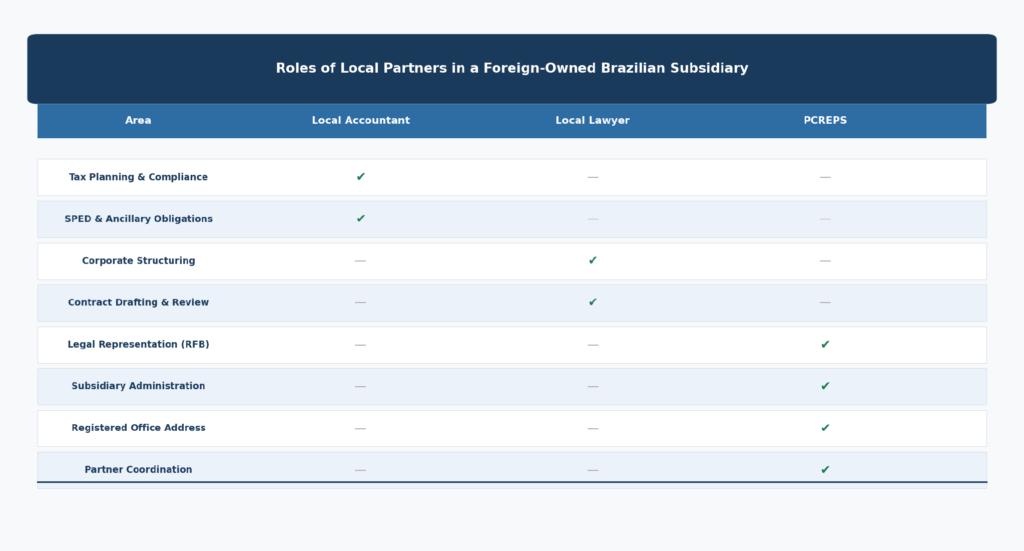
Connecting the Dots: The Role of PCREPS
While local accountants and lawyers provide the specialized technical advice, foreign investors still face a critical operational gap: who manages the day-to-day administration and acts as the legal face of the company in Brazil? This is where PCREPS steps in as your trusted local partner. We bridge the gap between foreign investors and specialized local advisors, positioning ourselves as “Business, Simplified.”
Our services are designed to complement, not replace, your legal and accounting partners. When specialized legal, tax, or regulatory advice is needed, we ensure that analysis is conducted by the appropriate experts. However, we provide the essential operational support that makes these partnerships work seamlessly: we act as the mandatory resident legal representative for the foreign shareholders and the Brazilian subsidiary; we manage the relationship with your chosen law firms and accounting providers; and we handle the administrative heavy lifting, ensuring that corporate books are updated, board meetings are organized, and the registered office address is maintained in compliance with local laws.
Maximize the value of your local partnerships. Contact PCREPS today to discover how our coordination and representation services can simplify your business operations in Brazil.