
Opportunities for Importers in Brazil’s E-commerce Market
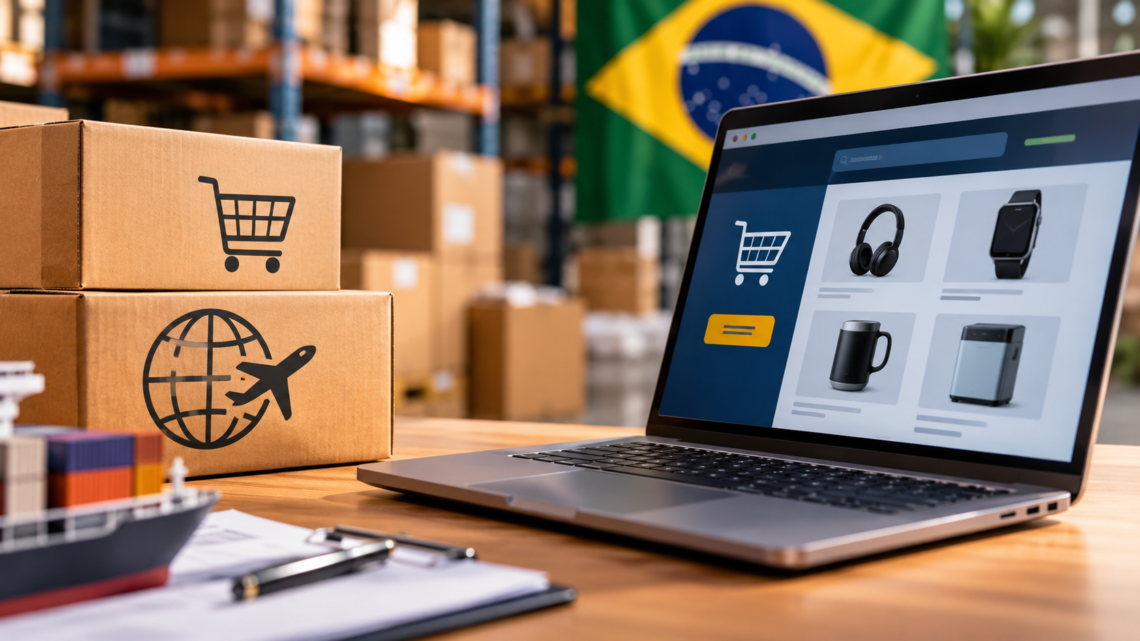
For an importer, e-commerce can be more than another sales channel. It can be the basis of a business that connects overseas manufacturers with Brazilian marketplace sellers, branded online stores and the fulfillment operations that serve their customers. The opportunity lies in supplying products that can be listed accurately, replenished reliably and delivered through a workable domestic operation. For international companies, this creates several possible roles: selling imported inventory directly, supplying local digital retailers, representing an overseas brand commercially or coordinating an assortment across online channels.
The scale of the market provides a reason to examine those models. According to ABIACOM, in “Crescimento do e-Commerce no Brasil,” the series “Principais Indicadores do e-Commerce: 2020 / 2025,” consulted on 3 November 2026, reports Brazilian e-commerce revenue of R$235.52 billion in 2025, versus R$204.27 billion in 2024. The same series records 438.92 million orders and 94.23 million online buyers in 2025. These figures describe e-commerce overall, not sales of imported products specifically. For importers, they establish the scale of the channel; the business opportunity still needs to be demonstrated through product demand, service quality and achievable margins.
Marketplaces as a route to market for imported products
An importer can evaluate selling through marketplaces rather than building an entire retail audience from the outset. The commercial task is to turn an imported assortment into listings that customers can understand and an order flow the seller can actually support. Product descriptions, images, specifications, stock information and price positioning should be designed around the Brazilian buyer. A catalogue copied from an overseas supplier may omit the information needed to judge compatibility, dimensions or practical use.
A marketplace strategy should also distinguish direct retail from wholesale supply. An importer may operate its own seller account, or it may supply independent merchants that already sell online. The first model gives the importer responsibility for retail pricing and channel execution. The second centres on product availability, commercial terms and replenishment for other businesses. Both require a review of platform rules and operating costs. Marketplace participation should be treated as a distribution option, not as proof that the assortment will sell or that traffic will translate into profit.
Fulfillment connects imported inventory with the online order
Fulfillment covers the operational work needed to turn available inventory into an order delivered to the customer. In the business models considered here, that can include receiving and storing goods, identifying units, picking orders, packing shipments and coordinating delivery. For importers, its importance is practical: purchasing a shipment is not the same as being able to process individual online orders. A product can be available in Brazil but still be unsuitable for a smooth retail operation if it lacks the required preparation or stock visibility.
Marketplace programs offer concrete examples of how those activities can be organised. Mercado Livre’s official guidance “Como começar a vender com o Envios Full,” consulted on 3 November 2026, sets out seller and product eligibility requirements and notes that activation for new sellers also depends on available capacity in its distribution centres. In the section “Como preparar os produtos para enviar ao Full?” of its official Full service page, consulted on the same date, Mercado Livre describes individual packaging and unit identification before goods enter the operation. An importer should therefore plan inbound preparation and confirm access before allocating inventory to that channel.
Amazon provides another example. According to Amazon Brasil, in the section “O que é FBA – Fulfillment da Amazon?” of its official FBA program page, consulted on 3 November 2026, eligible sellers send inventory to Amazon distribution centres, where Amazon manages inventory and outbound order logistics. The page describes delivery, package handling and customer service, including refunds and returns. Amazon’s “Central de treinamento FBA (Fulfillment by Amazon),” consulted on the same date, explains seller-side steps such as creating inbound shipments, preparing products and managing stock through reports. Eligibility, product restrictions and operating conditions must be checked; the service is not universally available to every seller or item.
The opportunity for an importer is not simply to transfer goods to a marketplace warehouse. It is to develop a supply operation that consistently delivers suitable inventory into the selected fulfillment process. This may involve product identification, packaging arrangements with manufacturers, inspection of incoming batches and replenishment planning. Outsourcing order handling can change the tasks the importer performs, but does not eliminate the need to control the assortment, its quality and the availability of replacement stock.
Supplying the sellers who need inventory, not an import department
A focused business model is to supply Brazilian online sellers with imported products already available domestically. Instead of requiring every merchant to negotiate with factories and coordinate international purchases, an importer can offer an organised local catalogue and repeat supply. The commercial proposition might include smaller replenishment orders, reliable product data and preparation compatible with the retailer’s chosen operation. Those are capabilities to develop and validate, not benefits that follow automatically from having a distribution company.
For example, an importer could investigate a specialised assortment of workspace accessories and supply several independent digital retailers. It could structure wholesale terms, maintain product specifications and prepare goods for agreed fulfillment requirements. This is an illustrative model, not a claim that the category has guaranteed demand. The key assessment is whether merchants value the availability and service enough to support the importer’s costs and margin, and whether competing suppliers already provide an equivalent offer.
A manufacturer-backed importer could also evaluate a local launch partnership with a foreign brand. In that model, the importer combines sourcing and supply with catalogue preparation and channel coordination, while retailers or commercial partners handle defined parts of customer acquisition. Contracts should distinguish commercial exclusivity, pricing authority, responsibility for inaccurate product information and treatment of defective stock. The brand relationship should support a clear operation rather than create overlapping obligations among participants.
Local stock and replenishment as business capabilities
Local inventory can help an importer participate in domestic e-commerce fulfillment, but inventory management determines whether that participation is workable. The business should distinguish goods held as a central reserve from units assigned to each sales channel. It should also decide how orders and returns change the quantity available for sale. An item recorded as available in several channels must not inadvertently be sold more than once.
Replenishment needs to connect overseas purchasing cycles with domestic order activity. Supplier minimum quantities, production schedules, transport, receipt and preparation all affect when replacement stock becomes usable. A pilot should examine how frequently each item sells, how much remains unsold and what happens if demand changes. The importer can then assess whether to expand an assortment or concentrate on fewer products. Imported stock is a business asset only when its purchasing and holding costs remain compatible with actual sales.
Marketplace fulfillment, independent logistics or a hybrid model
An importer need not assume that every channel must use the same fulfillment arrangement. Marketplace-managed fulfillment can be assessed for eligible products sold on that platform. An independent logistics provider may be evaluated for an owned store or a multi-channel operation. A hybrid model might place selected fast-moving items in marketplace inventory while retaining other stock in a central operation. Each structure should be tested against product handling, stock visibility, fees and customer-service requirements.
Contracts with a third-party logistics provider should specify receiving procedures, picking accuracy, packaging, shipment records and how returns are assessed. They should also address inventory discrepancies and the process for recovering stock if the relationship ends. For a foreign importer, the important distinction is between outsourcing physical tasks and retaining commercial oversight. A warehouse service cannot make an unsuitable assortment viable, and a software connection cannot compensate for inaccurate product or inventory records.
Product economics include fulfillment, not just import cost
A viable e-commerce assortment should be evaluated at the level of the sale, not solely at the level of the international purchase. Beyond sourcing and import costs, the calculation should consider marketplace charges, advertising, inbound preparation, storage, picking and packing, delivery and returns. Mercado Livre, in the section “O que você paga ao vender com o Full” of its official service page, consulted on 3 November 2026, states that selling fees continue to apply alongside daily storage charges determined by unit dimensions and weight, and that additional costs may arise from stock management. The published structure illustrates why fulfillment costs belong in product selection.
Physical characteristics can influence that selection. A compact product with simple preparation may require a different operating budget from a fragile or bulky item, even if their purchase prices are similar. The importer should examine the packaged unit and the expected order, not just the unboxed product. Slow-moving stock, damage and returns should be considered alongside the margin on a successful sale. Before scaling, the company needs evidence that the economics remain workable after the full order process and the cost of replenishment.
A local structure that supports online sales
Commercial imports and marketplace fulfillment are separate stages. According to the Brazilian Federal Revenue Service (Receita Federal), in “Manual de Habilitação no Siscomex,” updated on 24 September 2026, imports can be organised on a company’s own account or through the regulated arrangements known as “por conta e ordem” and “por encomenda.” The appropriate structure should be assessed for the actual participants and transaction. Marketplace acceptance or warehouse receipt is not a substitute for meeting the import requirements.
The product itself also needs review. Inmetro, in “Como solicitar anuência para importação,” updated on 19 August 2026, directs importers to verify the NCM classification, administrative treatment and applicable product regulation, including any certification, registration or approval requirements. For online consumer sales, the Brazilian House of Representatives’ publication of “Decreto nº 7.962, de 15 de março de 2013” sets out duties concerning clear product and supplier information, offer conditions, customer service and the right of withdrawal. These requirements should inform the operating model without turning the commercial opportunity into an assumption of automatic compliance.
How PCREPS fits into the importer’s e-commerce operation
PCREPS can support the local corporate foundation through legal representation of foreign investors and non-resident directors, administration of Brazilian subsidiaries and branches, registered-office services and coordination with Brazilian lawyers, accountants, financial consultants and other specialists. This can help an international importer organise its local interface while its commercial team and specialist providers address marketplace onboarding, product requirements and fulfillment. PCREPS does not provide warehousing or promise marketplace admission, sales growth or profitability. A registered office is not a distribution centre. This article is general information and does not replace specific legal, customs, tax or investment advice. Would you like to discuss how PCREPS can support your company’s local structure for supplying and selling imported products through Brazilian e-commerce?