

Legal Representation for Foreign Investors: What You Need to Know
Para investidores estrangeiros que entram no Brasil, a representação legal não é uma formalidade periférica . É um dos fundamentos práticos que permite a um investidor sediado no exterior interagir com as autoridades brasileiras, realizar atos societários, manter a regularidade dos registros, receber comunicações oficiais e manter a estrutura local alinhada às exigências do ambiente de negócios brasileiro.
This is particularly relevant because foreign investment in Brazil often creates obligations beyond the commercial relationship between shareholders. The Brazilian Federal Revenue Service states, in its official guidance for legal entities domiciled abroad, that foreign entities investing in equity interests in Brazilian legal entities may be required to register with the CNPJ. In practice, this means that the investor’s presence in Brazil must be supported by proper documentation, representation, and administrative traceability from the beginning.
A legal representative acts as the local bridge between the foreign investor and the Brazilian administrative system. Depending on the powers granted, the representative may interact with public authorities, receive notices, sign documents, support registration procedures, coordinate formal requirements, and help ensure that the investor is properly represented in corporate acts. The exact scope should always be defined in a power of attorney with clear, proportional, and well-drafted powers.
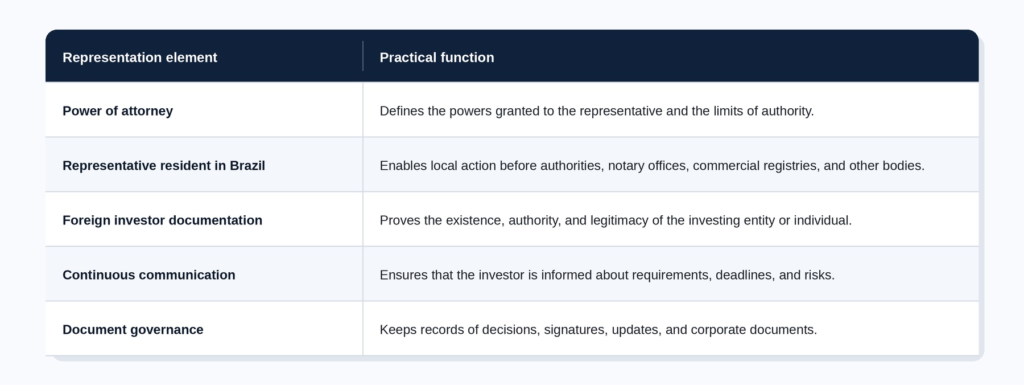
The role becomes even more important when the investor is not physically present in Brazil. A foreign shareholder may need to respond to registration requirements, approve corporate amendments, update documents, interact with banks, appoint managers, or support accounting and tax routines. Without a reliable local point of contact, simple administrative steps may become slow, fragmented, and difficult to control.
It is also important to distinguish legal representation from company management. A representative of the foreign investor acts on behalf of the shareholder or quota holder within the limits of the powers granted. A company manager or officer, by contrast, conducts the day-to-day management of the Brazilian entity and assumes responsibilities under the company’s governing documents and applicable law. These functions may interact, but they should not be confused.
The DREI, Brazil’s National Department of Business Registration and Integration, has also clarified rules involving administrators resident or domiciled abroad, including the need for a representative residing in Brazil with powers to receive service of process for a minimum period after the end of the administrator’s term. This reinforces a broader point: when decision-makers or investors are outside Brazil, the local representation structure must be carefully designed to preserve legal effectiveness, continuity, and accountability.
A professional representation structure should be built with governance in mind. The most effective arrangements usually define who may act, which documents may be signed, how communications will be reported, where records will be stored, and when powers should be reviewed. This reduces ambiguity and helps foreign investors maintain control over their Brazilian presence without needing to manage every operational detail directly.
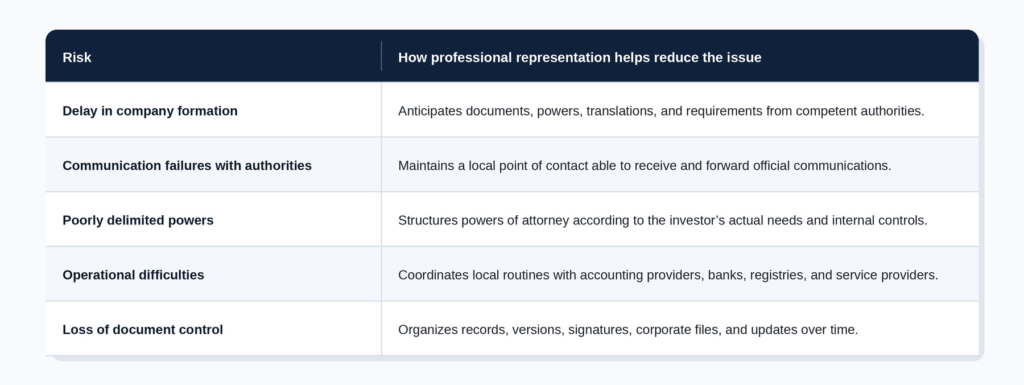
For international groups, the choice of representative should consider not only trust, but also technical familiarity with Brazilian routines. The representative should understand how foreign documents are legalized or apostilled, when sworn translations may be necessary, how commercial registries and notary offices operate, and how to coordinate with accounting, banking, legal, and administrative providers. Language capability is also relevant, especially when the investor’s internal teams operate in English, Spanish, or another language.
PCREPS operates precisely at this point of the investor journey. The company supports foreign investors with legal representation, representation for non-resident directors, administration of subsidiaries and branches, registered office address, and local operational support. For companies abroad, this means having a partner in Brazil capable of transforming regulatory and administrative requirements into a more organized, predictable, and manageable process.
Legal representation should therefore be understood as part of the investor’s market-entry infrastructure. It supports company formation, but it also remains relevant after incorporation, when the business begins to operate, hire providers, sign documents, update registrations, maintain records, and respond to local demands. A well-structured representative does not replace strategic decision-making by the investor; instead, it helps ensure that those decisions can be implemented properly in Brazil.
In 2026, foreign investors are likely to continue demanding more governance, transparency, and operational predictability in cross-border structures. For Brazil-bound investments, legal representation is one of the mechanisms that helps translate those expectations into practical control. It reduces friction, improves communication, and allows the foreign investor to operate with greater confidence in a jurisdiction where formalities, documentation, and timing matter.
For companies planning to invest in Brazil, the key question is not simply whether a representative is required. The better question is whether the representation structure is clear, reliable, and aligned with the investor’s long-term goals. When properly planned, legal representation becomes a strategic tool for compliance, governance, and operational continuity.
With PCREPS, foreign investors can rely on a local partner prepared to simplify bureaucracy, support compliance, and facilitate the administration of Brazilian subsidiaries and investment structures. For an investor outside the country, that local presence can make the difference between a slow and uncertain entry and a structured expansion conducted with confidence from the start.