

How to Participate in Public Tenders in Brazil as a Foreign Company
For many foreign companies, Brazil’s public sector represents a significant commercial opportunity. Federal agencies, state governments, municipalities, public universities, hospitals, infrastructure bodies and government-controlled entities regularly purchase goods, services, technology, engineering solutions and specialized support. However, the practical question is rarely whether the opportunity exists. The real question is whether a foreign company can navigate Brazil’s procurement environment with the right structure, documentation, timing and local execution capacity.
Brazilian public tenders are formal, document-intensive and highly procedural. A technically strong international supplier may still face difficulties if its corporate documents are not properly translated, if it lacks a local representative, if the tender requires registration in a Brazilian supplier system, if tax and labor compliance documents are not available, or if the company misunderstands how the bidding notice governs the process. The Brazilian Public Procurement Law, Law No. 14,133/2021, establishes the general framework for public procurement and administrative contracts across the direct, autarchic and foundational public administrations of the Union, States, Federal District and Municipalities. The same law also emphasizes principles such as legality, publicity, transparency, equality, objective judgment, legal certainty and competitiveness.
For foreign investors, this means that participation is possible, but it must be prepared carefully. Public procurement in Brazil is not simply a sales activity. It is a regulated process that connects corporate registration, legal capacity, technical qualifications, financial evidence, compliance declarations, electronic platforms, formal communications and contract execution. Understanding this structure before submitting a proposal is essential.
The Brazilian public procurement environment
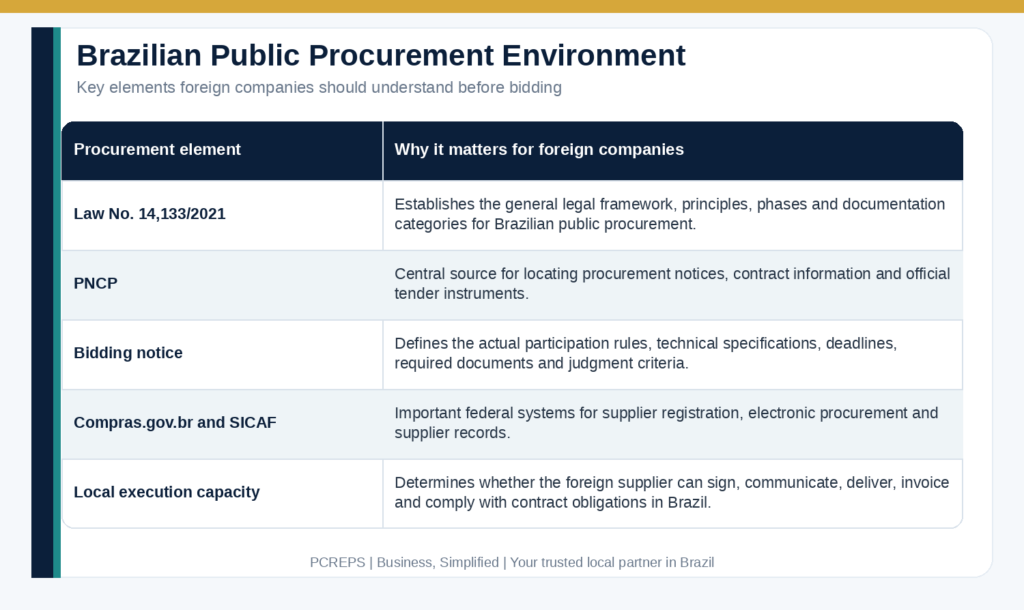
Public procurement in Brazil is the process through which the Public Administration contracts works, services, purchases and disposals, as explained by Brazil’s Transparency Portal, maintained by the Office of the Comptroller General. In practice, government entities publish procurement notices, define technical requirements, establish participation conditions, receive proposals and select suppliers according to objective criteria.
The most important legal framework is Law No. 14,133/2021, known as the Brazilian Public Procurement and Administrative Contracts Law. It applies to a broad range of purchases, services, works, leases, concessions of use and information technology contracts. It also defines the concept of an international tender. Under the law, an international tender is a bidding procedure processed in Brazil in which foreign bidders are admitted, with the possibility of price quotation in foreign currency, or a procedure in which the contractual object may or must be performed, wholly or partly, outside Brazil.
A central platform in this environment is the Portal Nacional de Contratações Públicas, known as PNCP. The PNCP publishes procurement notices and other procurement instruments. The portal itself describes the bidding notice as the internal law of the tender because it binds all parties, sets the applicable rules and criteria, and defines the conditions for interested parties to participate in the supplier selection process. For a foreign company, this is a critical point: the general law matters, but the specific notice determines the operational requirements of each opportunity.
Can a foreign company participate in Brazilian public tenders?
Yes, foreign companies may participate in Brazilian public tenders when the applicable law and the bidding notice allow their participation and when the company can meet the required documentation, qualification and execution conditions. Law No. 14,133/2021 expressly recognizes international bidding and includes rules designed to avoid improper access barriers to foreign bidders.
The law also states that the bidding process may not establish differentiated commercial, legal, labor, social security or other treatment between Brazilian and foreign companies, including matters related to currency, payment method and place of payment. In international tenders, when a foreign bidder is allowed to quote prices in foreign currency, Brazilian bidders must be allowed to do the same. The law further provides that the bidding notice may not create habilitation, classification or judgment conditions that constitute access barriers to foreign bidders, although legally permitted margins of preference for goods produced in Brazil and national services may apply in certain cases.
This does not mean that foreign companies face no requirements. On the contrary, the principle is equal access under the conditions of the tender, not exemption from formal obligations. A foreign company may need to present equivalent corporate documents, translated documents, proof of legal existence, technical certificates, financial evidence, declarations, powers of attorney, professional registrations, or local authorizations depending on the nature of the object and the terms of the notice.
The bidding notice is the starting point
Foreign companies should begin every opportunity with a detailed review of the bidding notice and its annexes. In Brazil, the notice is not a marketing document. It is the controlling document of the procedure. It establishes the scope, qualification requirements, proposal format, technical standards, deadlines, communication channels, contract terms, penalties, performance guarantees, delivery conditions and payment rules.
A common mistake is to evaluate a tender only from a commercial perspective. A foreign supplier may see a strong fit between its solution and the government’s needs, but the tender may require documents that take weeks to prepare, local professional registration, proof of previous experience in a specific format, Portuguese translations, electronic platform credentials or a Brazilian entity capable of signing and executing the contract. Missing one formal requirement can result in disqualification even when the company’s product or service is competitive.
A practical review should answer three questions. First, is the tender open to foreign bidders, either expressly or by structure? Second, can the company meet the habilitation requirements within the deadline? Third, if awarded, can the company execute the contract in Brazil in a compliant and commercially viable manner?
Documentation and habilitation requirements
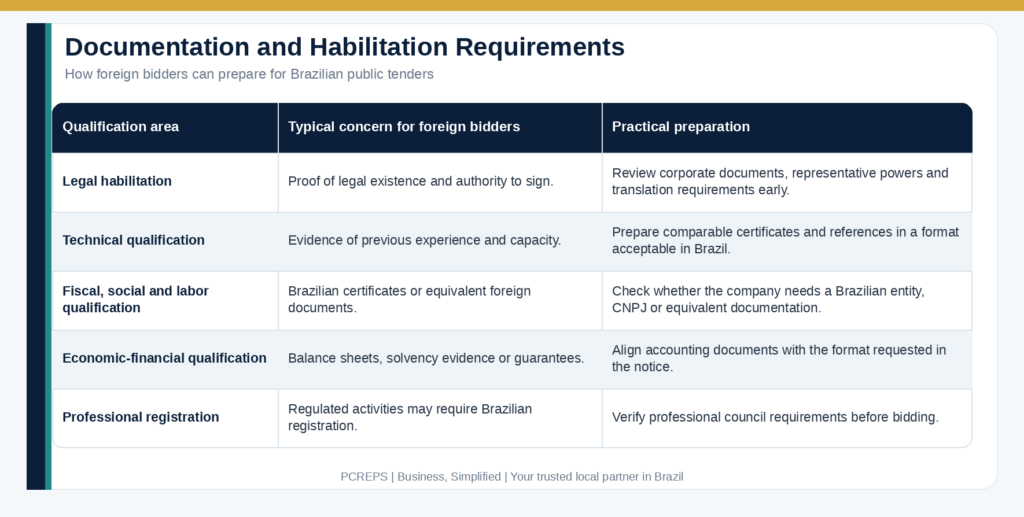
Law No. 14,133/2021 defines habilitation as the phase in which the procurement authority verifies the information and documents necessary and sufficient to demonstrate the bidder’s capacity to perform the contract. The law organizes habilitation around legal, technical, fiscal, social, labor and economic-financial dimensions. The exact documents depend on the notice, the type of contract and the public entity involved.
For foreign companies, legal habilitation usually begins with evidence that the company legally exists and has authority to assume obligations. This may involve certificates of incorporation, bylaws or articles of association, good standing documents, corporate resolutions, powers of attorney and identification of authorized representatives. When documents are issued abroad, the tender may require legalization, apostille procedures, sworn translation into Portuguese or other formalities.
Technical qualification is often decisive. The company may need to present certificates, references, previous contract evidence, proof of technical capacity, manufacturer authorizations, professional registrations or evidence that it has performed similar services. Law No. 14,133/2021 provides that certificates or equivalent documents issued by foreign entities may be accepted when accompanied by Portuguese translation, unless the issuing entity is proven unreliable. For regulated activities, foreign business companies may also need to request registration before the competent professional entity in Brazil at the contract signing stage, depending on the applicable requirement.
Economic-financial qualification may require balance sheets, financial statements, solvency indicators, guarantees or evidence of financial capacity. Fiscal, social and labor qualification may require certificates that are straightforward for Brazilian companies but more complex for foreign companies without a Brazilian presence. Law No. 14,133/2021 states that foreign companies that do not operate in Brazil must present equivalent documents according to federal regulation.
Supplier registration, SICAF and electronic platforms
Many public tenders in Brazil are processed electronically. For federal procurement, foreign companies may encounter Compras.gov.br and the Sistema de Cadastramento Unificado de Fornecedores, known as SICAF. The Federal Government Procurement Portal describes SICAF as the entry point for suppliers, whether companies or individuals, to begin selling to government agencies. It also states that SICAF records occurrences during the execution of contracts signed with the Public Administration. The same portal explains that suppliers must register with Compras.gov.br, the daily work tool through which companies and individuals access the system environment for selling to the government.
Registration requirements may vary according to the system, entity and tender. Some procurement opportunities may be published in PNCP but conducted through a federal, state, municipal or private electronic platform accredited for public procurement. Foreign companies should therefore identify not only the notice but also the operational platform where proposals, documents and appeals must be submitted.
This is one reason why local coordination matters. Platform access may require credentials, user management, digital certificates, representative identification, local contact information and careful monitoring of deadlines. Tender deadlines in Brazil can be strict, and electronic sessions may require real-time participation in Portuguese.
Do foreign companies need a Brazilian entity or CNPJ?
There is no single answer for every tender. Some international tenders may allow direct participation by a foreign company that does not yet operate in Brazil, subject to equivalent documents and the specific conditions of the notice. Other opportunities may be more practical, or effectively necessary, through a Brazilian subsidiary, branch, local partner, consortium or representative structure.
The CNPJ, administered by Receita Federal do Brasil, is the Brazilian taxpayer identification registry for legal entities and other arrangements required to register. In procurement practice, a CNPJ can be relevant for supplier registration, invoicing, tax compliance, contract execution, local banking, hiring, importation and administrative communication. Corporate registration and the structuring of a Brazilian subsidiary or branch may involve rules and procedures connected to commercial registries and DREI guidance, depending on the legal form and state of registration.
Foreign companies should assess this issue before pursuing a tender, not after winning it. If the contract requires local performance, Brazilian invoicing, local licenses, employees, technical registration or ongoing support, a formal structure in Brazil may be needed. If the opportunity allows performance from abroad, the foreign entity may still need a local representative or appointed attorney to handle communications, documents and procedural acts.
The decision should be made with appropriate legal, tax and accounting advisors. PCREPS can coordinate the operational and representation aspects of this process, but specialized advice may be necessary to define the correct legal and tax structure for each case.
Key risks for foreign bidders
The most visible risk is disqualification for incomplete or non-compliant documentation. However, foreign companies also face several less obvious risks. One is timing. Apostilles, sworn translations, notarizations, corporate approvals and powers of attorney may take longer than the tender calendar allows. Another is communication. Public procurement procedures are conducted in Portuguese, and questions, challenges, appeals and clarifications must be handled precisely.
A third risk is misunderstanding the difference between being eligible to bid and being ready to perform. Winning a tender may trigger obligations related to performance guarantees, contract signing, tax registration, local delivery, technical assistance, data protection, labor compliance, import procedures, invoicing and interaction with public contract managers. A foreign company that has not planned these steps may face delays or penalties.
Compliance is also critical. Public procurement requires transparent conduct, accurate declarations and careful management of conflicts of interest, sanctions, anti-corruption controls and documentation integrity. Companies involved in projects financed by international organizations may also need to observe sanctions lists or specific procurement rules, as recognized by Law No. 14,133/2021 for certain financed projects.
Best practices before submitting a proposal
Foreign companies should treat Brazilian public tenders as a structured market-entry project. The first step is opportunity screening. Not every tender is suitable for a foreign bidder, even if the technical scope appears attractive. The company should evaluate eligibility, documentation, platform access, language requirements, delivery obligations, currency rules, tax implications and local execution needs.
The second step is document readiness. Corporate records, technical certificates, financial statements, powers of attorney and representative authorizations should be organized before the company identifies a high-value tender. This preparation can significantly reduce execution risk when deadlines are short.
The third step is local role definition. The company should decide whether it will bid directly, through a Brazilian subsidiary, through a branch, in consortium, through a local partner, or with a representative supporting procedural acts. Each model has different legal, tax, commercial and governance implications.
The fourth step is compliance review. Before submitting declarations, the company should confirm that all statements are accurate and that it can maintain the required conditions throughout the procurement procedure and contract term. In Brazil, the contractor is generally expected to maintain the qualification conditions required in the tender during contract execution.
How PCREPS supports foreign companies in Brazilian public tenders
PCREPS helps foreign companies make participation in Brazilian public tenders more organized, predictable and locally executable. As a trusted local partner in Brazil, PCREPS supports international investors that need a reliable operational presence, local representation and coordination with specialized advisors.
In the context of public tenders, PCREPS can assist with representation in public tenders, local coordination, document workflow, registered office address support, administration of subsidiaries and branches, legal representation for foreign investors and non-resident directors, and coordination with law firms, accountants, financial advisors and other professional partners. This support can be especially valuable when a foreign company needs to align the commercial opportunity with Brazilian registration, governance, documentation and compliance routines.
PCREPS does not replace specialized legal, tax, accounting or regulatory advice when such advice is required. Instead, it helps connect the operational pieces that often determine whether a foreign company can participate effectively: who receives notices, who signs documents, who coordinates translations, who follows platform deadlines, who interacts with local partners, who supports the Brazilian entity and who ensures that administrative steps do not fall between jurisdictions.
For foreign companies, this is where “Business, Simplified” becomes practical. The objective is not to remove the formal nature of Brazilian procurement, but to make it manageable through local structure, reliable representation and disciplined execution.
Final thoughts
Brazilian public tenders can offer meaningful opportunities for foreign companies, but they require more than a competitive product or service. They require procedural readiness, documentation discipline, local coordination and a clear understanding of the bidding notice, PNCP, electronic platforms, habilitation requirements and contract execution obligations.
A foreign company that prepares early is in a stronger position to evaluate opportunities, avoid disqualification, manage compliance risks and decide whether a Brazilian entity, local representative, consortium or partner structure is appropriate. In a market where public procurement is formal and deadlines matter, preparation is often the difference between a promising opportunity and a missed one.
If your company is evaluating public tenders in Brazil, PCREPS can help you understand the local operational requirements, organize the representation and support structure, and coordinate the professionals needed for a compliant and practical market approach.
Contact PCREPS to discuss how your company can structure its participation in Brazilian public tenders with a trusted local partner.