

Strategic Partnerships: How Local Accountants and Lawyers Boost Your Business in Brazil
Expanding a business into Brazil offers access to the largest economy in Latin America, a vast consumer market, and abundant natural resources. However, foreign investors often face a significant hurdle: the sheer complexity of the Brazilian regulatory, legal, and tax environment. Navigating this landscape without specialized local knowledge is a risky endeavor that can lead to severe operational bottlenecks, financial penalties, and compliance failures.
For international companies, the difference between a successful market entry and a costly withdrawal often lies in the quality of their local support network. Building strategic partnerships with local accountants, lawyers, and operational partners is not merely an administrative requirement; it is a fundamental strategy for sustainable growth. These professionals provide the essential expertise needed to interpret complex regulations, ensure strict compliance, and establish robust corporate governance structures.
The Complexity of the Brazilian Business Environment
Brazil operates under a civil law system with a highly intricate tax code and stringent regulatory frameworks. Foreign companies must comply with obligations at the federal, state, and municipal levels, each with its own set of rules and reporting deadlines. The regulatory landscape is continuously evolving, demanding constant vigilance and adaptation.
One of the primary challenges is the tax system. The Brazilian Federal Revenue Service (Receita Federal) employs advanced digital reporting mechanisms, such as the Public Digital Bookkeeping System (SPED), which cross-references financial, accounting, and tax data in real time. Any discrepancy between the information submitted and the actual financial transactions can trigger automatic audits and substantial fines. Companies must manage a broad range of federal taxes, including the Corporate Income Tax (IRPJ) and the Social Contribution on Net Profit (CSLL), in addition to state and municipal levies.
Furthermore, corporate governance and data protection have become increasingly rigorous. The Brazilian General Data Protection Law (LGPD), enforced by the National Data Protection Authority (ANPD), mandates strict rules for the processing of personal data. ANPD Resolution No. 18, published in July 2024, requires companies to formally appoint a Data Protection Officer (DPO) through a written, dated, and signed document, and to publicly disclose the DPO’s contact information on their website. This regulation emphasizes the need for robust internal controls and compliance programs that go well beyond a simple administrative checkbox.
The Risks of Operating Without Local Expertise
Attempting to manage a Brazilian subsidiary or branch without the guidance of local accountants and lawyers exposes foreign investors to significant practical risks. These risks span across various operational areas, including governance, compliance, and documentation.
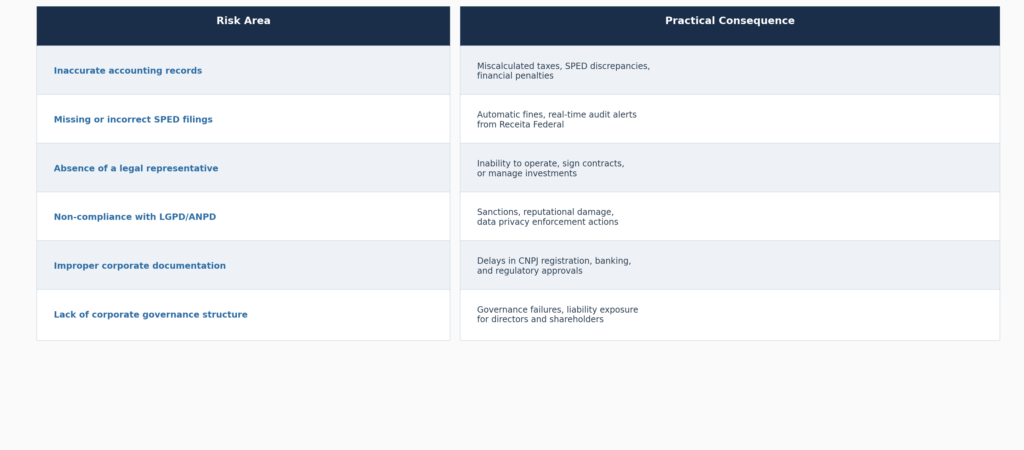
A common pitfall is the failure to maintain accurate accounting records in accordance with Brazilian accounting standards, which are aligned with the International Financial Reporting Standards (IFRS) but contain specific local adaptations. Incorrect bookkeeping can lead to miscalculated taxes, resulting in severe financial penalties. Additionally, the lack of proper documentation, such as translated and apostilled corporate records, can delay critical processes like obtaining a CNPJ (Cadastro Nacional da Pessoa Jurídica, the National Registry of Legal Entities, administered by the Receita Federal) or opening a corporate bank account.
Another critical risk involves legal representation. Brazilian law requires foreign shareholders and non-resident directors to appoint a legal representative residing in Brazil. This representative is legally responsible for the company’s actions and must interface with government authorities. Without a trusted local partner acting as the legal representative, foreign investors cannot legally operate, sign contracts, or manage their investments in the country.
The table below summarizes the main risk areas and their practical consequences for foreign companies operating in Brazil:
How Strategic Partnerships Mitigate Risks and Drive Growth
Establishing strategic partnerships with experienced local professionals transforms these challenges into manageable processes. Local accountants and lawyers provide invaluable insights and practical solutions that safeguard the company’s interests and facilitate smooth operations.
Ensuring Tax and Accounting Compliance
Local accountants play a crucial role in ensuring that all financial records are accurate and compliant with Brazilian standards. They manage the complex SPED filings, ensuring that all digital reports are submitted on time and without discrepancies. By maintaining meticulous accounting practices, they help foreign companies avoid fines, optimize their tax burdens, and maintain financial transparency. Accounting records in Brazil must be retained for a minimum of five years, aligned with the tax statute of limitations, and must be supported by proper documentation including invoices, contracts, bank statements, and payroll records.
Navigating Legal and Regulatory Frameworks
Brazilian lawyers are essential for interpreting the intricate legal system and ensuring that the company’s operations align with all regulatory requirements. They assist in structuring the business entity, drafting contracts, and navigating labor laws. Their expertise is particularly vital when dealing with regulatory bodies such as the Department of Business Registration and Integration (DREI) and the Central Bank of Brazil (Banco Central do Brasil), ensuring that all registrations and foreign capital declarations are correctly filed through the appropriate channels, including the REDESIM portal for company registration.
Establishing Robust Corporate Governance
Strategic partnerships also enhance corporate governance. Local experts assist in implementing internal controls, compliance programs, and data protection policies that align with both international standards and Brazilian laws. This proactive approach not only mitigates legal risks but also builds trust with local stakeholders, customers, and regulatory authorities. For companies subject to the LGPD, having a properly structured DPO function, supported by local legal expertise, is a regulatory obligation, not merely a best practice.
PCREPS: Your Trusted Local Partner in Brazil
While accountants and lawyers provide specialized technical advice, foreign investors also require a reliable partner to coordinate these efforts and manage the day-to-day administration of their Brazilian operations. This is where PCREPS steps in as your trusted local partner, positioned to simplify business in Brazil.
PCREPS offers comprehensive operational support that bridges the gap between foreign investors and local technical experts. Our services are designed to ensure that your Brazilian subsidiary operates smoothly, allowing you to focus on your core business objectives.
We provide essential services such as legal representation for foreign investors and non-resident directors, ensuring that you meet all statutory requirements without exposing your international executives to local liabilities. Our administration of subsidiaries and branches covers everything from maintaining a registered office address to coordinating with your chosen law firms, accountants, and financial advisors.
Furthermore, PCREPS offers specialized DPO services to ensure full compliance with the LGPD and ANPD regulations, protecting your company from data privacy risks. We also assist with representation in public tenders, liquidation processes, and corporate-book custodian support, providing a complete suite of services for every stage of your business lifecycle in Brazil.
It is important to note that PCREPS acts as an operational support and local representation partner. We do not replace specialized legal, accounting, tax, or regulatory advice when required. Instead, we work collaboratively with your specialized advisors, coordinating their efforts to ensure a cohesive and efficient operational structure.
Conclusion
Entering the Brazilian market requires more than just capital and a solid business plan; it demands a deep understanding of the local environment and a robust support network. Strategic partnerships with local accountants and lawyers are indispensable for navigating the complexities of tax compliance, legal regulations, and corporate governance.
By partnering with PCREPS, foreign investors gain a reliable operational ally that simplifies bureaucracy, coordinates with technical experts, and ensures that their Brazilian presence is secure, compliant, and positioned for success.
If you are planning to expand your business into Brazil or need to optimize your current operations, having the right local partner is crucial. Contact PCREPS today to discover how our tailored operational support and legal representation services can simplify your business journey in Brazil.