

How to Structure a Foreign-Owned Company in Brazil in 2026
Entrar no mercado brasileiro pode ser uma jogada estratégica para empresas internacionais que buscam crescimento na América Latina, acesso a uma ampla base de consumidores, proximidade com cadeias de suprimentos relevantes e oportunidades em setores como tecnologia, energia, serviços financeiros, entretenimento, manufatura e infraestrutura. No entanto, estabelecer uma empresa estrangeira no Brasil exige mais do que uma decisão comercial. Envolve a estrutura corporativa adequada, representação local, registros fiscais, coordenação com bancos, interação com as autoridades brasileiras e uma rotina operacional capaz de manter a empresa em conformidade desde o primeiro dia.
For foreign investors, the key point is to understand that Brazil allows foreign shareholders to participate in local companies, but it requires accurate documentation and administrative organization. The Brazilian Federal Revenue Service states, in its guidance for legal entities domiciled abroad, that foreign entities may be required to register with the CNPJ when they invest in equity interests in Brazilian legal entities. In practice, this means that proper structuring begins before the subsidiary is incorporated: it begins with preparing the foreign investor to operate formally within the Brazilian regulatory environment.
The first major decision is usually the choice of legal structure. In many cases, international investors choose to incorporate either a limited liability company or a corporation, depending on the investment profile, number of shareholders, expected governance, capital planning, and exit strategy. A limited liability company is often used for leaner operations, while a corporation may be more suitable when there are multiple investors, investment rounds, more sophisticated governance arrangements, or a need for a more formal corporate structure.
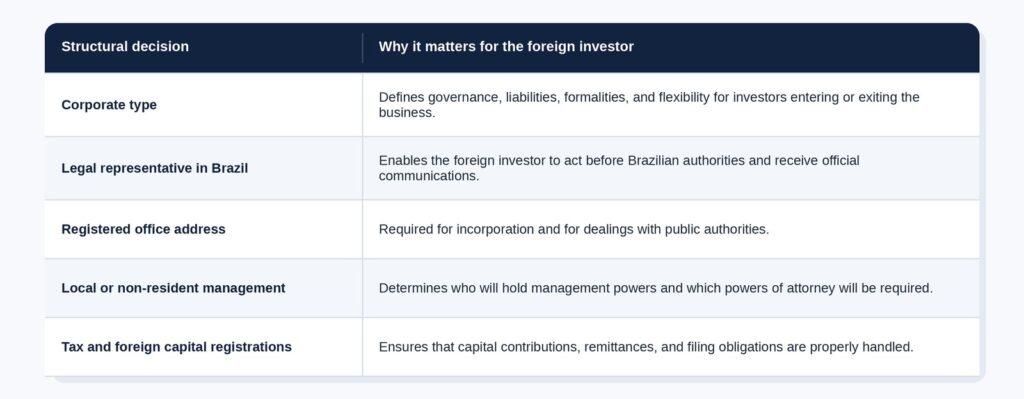
Once the structure has been defined, the foreign investor must organize corporate documentation and representation in Brazil. This is a sensitive point because documents issued abroad generally need to go through validation, sworn translation, and adaptation to Brazilian requirements. In addition, the local representative must hold appropriate powers to act within the limits established by the investor, without creating unnecessary governance risks.
In 2026, efficient structuring will increasingly depend on the integration of legal strategy, administrative execution, and operational follow-up. Registering the company is not enough; the company must be able to operate. This includes a registered office address, CNPJ registration, applicable tax registrations, bank account opening, coordination with accounting providers, execution of documents, interaction with authorities, and maintenance of corporate books and records. Each individual step may seem simple, but together they often become complex for groups that are outside the country and do not follow Brazil’s bureaucracy on a daily basis.
This is where a local partner becomes decisive. PCREPS was created to simplify market entry and operations for foreign investors in Brazil, providing legal representation, operational support, administration of subsidiaries and branches, registered office address, support in public tenders, liquidation and custodian services, and DPO solutions. This combination allows investors to focus on business expansion while the bureaucratic side is handled with predictability, clear communication, and alignment with local requirements.
It is also important to distinguish the role of the investor from the role of the manager. A foreign shareholder may hold equity in the Brazilian company, but the management of the subsidiary must be structured in a way that is compatible with Brazilian law and the group’s governance model. When managers reside or are domiciled abroad, DREI/ME Normative Instruction No. 112/2022 provides that the investiture of a manager in that condition is subject to the appointment of a representative resident in Brazil, with specific powers. This requirement reinforces the importance of planning management and representation from the outset, avoiding registration delays and future difficulties with signatures or receipt of communications.
The ideal structure should also take capital flows into account. The entry of foreign investment into Brazil must be properly documented and monitored by professionals who understand the relationship between articles of association, registrations, banks, foreign exchange, accounting, and obligations before Brazilian authorities. The goal is not simply to open the company quickly, but to create a solid foundation to receive capital contributions, hire people, sign contracts, pursue commercial opportunities, and report to the controlling group abroad.
In practical terms, a foreign company planning to operate in Brazil in 2026 should organize its entry in phases. The first phase involves project diagnosis, structure definition, and document mapping. The second involves appointing representatives, preparing corporate documents, and filing with the competent authorities. The third involves obtaining registrations, setting up a registered office, and implementing the administrative routine. The fourth involves ongoing compliance, operational support, and local governance.
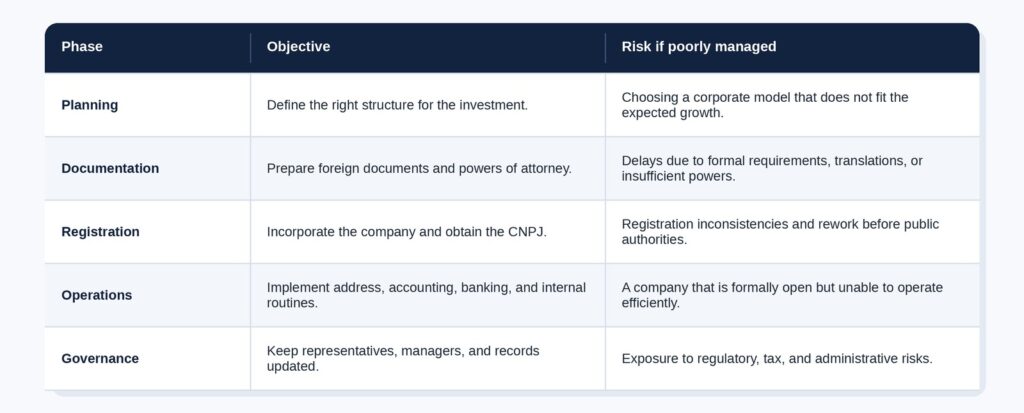
The best structure, therefore, is the one that combines legal certainty with practical execution. For foreign investors, Brazil offers relevant opportunities, but it also requires attention to local details. A well-structured subsidiary reduces risks, improves communication with authorities, facilitates relationships with banks and suppliers, and builds confidence in the market.
PCREPS operates precisely at this intersection between the global investor and the Brazilian operational reality. By providing representation, administrative support, and local coordination, the company helps international groups transform a Brazil market-entry plan into an operation that is truly ready to grow.